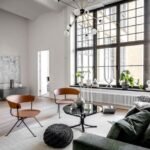
The fact that good design is invisible is what makes it so hard to appreciate. You walk into a well-designed store and its shelves seem perfectly ordered or you sit in a well-designed chair and don’t notice you’re sitting in a chair. This explains why the opportunities for people to say things like “if I were you, I’d rather spend that money on a tiny house and travel the world” are endless.
The part you see is the smallest part of the job
Clients may notice color palettes and furniture choices first – those are the most obvious design decisions, done last, visible on the surface. But a room’s appearance is really the last layer applied to a structure of decisions that started weeks or more likely months earlier – what is load bearing and where the walls must go (and stay), how the plumbing can feasibly run, what the family’s electrical load will bear, where the cat needs in and out, how a family of four actually moves through a kitchen at 7am on a school day.
This is where space planning does its quiet work. A living room can look flawless in a portfolio shot and still fail every day it’s lived in – a sofa that blocks the natural walking path to the garden, a dining table too close to a doorway, a home office wedged into a den where your life will insist on using that space as a guest room. Space planning isn’t about fitting furniture into a floor plan. It’s about mapping how people actually move, gather, and work, then building the room around that behaviour. Get it wrong and no paint colour fixes it.
Ergonomics is where comfort actually lives
Despite its importance, ergonomics is a design aspect that does not get much attention. Yet, it plays a significant role in how comfortable a living space is. For example, a kitchen counter that is just two inches too high can strain your shoulders every time you prepare a meal. Similarly, a desk that is too deep will force your monitor too far from your eyes, leading to frequent headaches that you may not realize are caused by the furniture.
Then there is a hallway that is too narrow to comfortably walk through, forcing you to navigate it sideways without ever questioning why that feels natural. None of these are obvious issues. They are minor, but repeated inconveniences that add up over time. A designer thinking about ergonomics is not nitpicking – they are eliminating dozens of small daily inconveniences that most people tolerate and never associate with the room’s design.
Health is a design decision, not a paint colour
This is the argument that tends to surprise people who think of interior design as purely visual: the materials and lighting in a home have a direct, measurable effect on physical health.
Start with air – paints, adhesives, carpets, and composite furniture all off-gas volatile organic compounds, and a poorly ventilated room concentrates them. Specifying low-VOC finishes, breathable materials, and adequate ventilation isn’t a wellness trend. It’s a direct intervention in indoor air quality, and it’s one of the least visible things a designer does – nobody photographs a paint can’s VOC rating.
Lighting does the same job using a different tool. Good lighting design has three layers: ambient light for basic vision, task light for detailed work, and accent light for depth and mood. Properly layered, lighting acts as a regulator for circadian rhythm – the internal clock that regulates sleep quality, alertness, even appetite. A house that only ever sees the single naked bulb hanging from the center of every room changes that in small ways every day. A house with warm, dimmable ambient light in the evening and bright, localized task light in the morning literally works with the body’s metabolism. This is engineering. It is not art.
Those engaged in environmental psychology know this more generally. Color, texture, proportion and natural light have all kinds of measured effects on mood, stress, and cognitive function. Biophilic design – adding natural light, plants, wood, and other living or derived-from-living materials – has consistently tested as one of the most motivating non-aesthetic priorities in design over the last 50 years because it significantly corresponds to lower stress and higher focus. This is not intuiting on the part of the competent designer. This is creating using observed psychological effects – the same way a competent copywriter chooses words for their proven impact on a reader rather than their impact on the page.
The invisible project management that prevents expensive mistakes
If you ask anyone who has ever renovated their house without professional help what made them go over budget, it won’t be the sofa they fell in love with. It’s the unexpected plumbing emergency, the electrician who was double-booked so you had to employ someone else at short notice, the discontinued tile, the too-big sofa that led to a five-digit reconfiguration of the sitting room. These are the day-to-day disasters of an unmanaged renovation, and they’re almost all unplanned – and therefore expensive.
What most homeowners perceive as the designer’s or architect’s job – throwing together some drawings and suggesting a nice paint color – is, in fact, one of the least time-consuming aspects of that person’s role on a project. When the hidden work of specification, budgeting, and trade management is handled by a specialist like Victoria Hughes Interiors, the client’s only job is to live well in the result. In the same way, material quality (and thus material cost) in anything isn’t always the most expensive product. It’s designed to last the longest. We see this with ten-year sofas, kitchens, and bathroom catastrophes where the chosen finishes can’t withstand the regular abuse they receive and yet they looked the part in a showroom. That’s the showroom ethos for you.
Regulations and structural limits are not optional extras
There is a set of design decisions clients will never see if they’re correctly handled, because they disappear into the final room: building codes and regulations. Power socket installation close to water areas, fire safety space around cooking appliances, structural constraints for a wall demolition, access needs for disabled individuals – these are not optional choices, they are mandatory. A professional designer handles all of it, partnering with structural engineers, electricians, and building control so that the “dream” actually can be built, is legal, and does not resemble a Pinterest board that falls apart on contact with an inspector.
This is also where the difference between home staging and home designing becomes clear. Staging plans a room to easily market it – rapidly, short-term, looks-first. Designing plans a room to be occupied for many years, under genuine regulatory and structural restrictions, by real people with actual lives. They may appear similar in a photo. But they are not the same occupation.
The money argument: design as investment, not expense
The notion that professional design is a luxury often crumbles if you examine resale statistics. Rational, well-considered design choices regularly contribute to raising property values more than do-and-pray styling – people will pay more for a space that reads as cohesive, functional, and well-lit, even when unable to pinpoint the reasons for their response. A bathroom or living room designed with considered space planning and adequate budget for suitable finishes doesn’t simply look better on resale; it will be valued higher since the appraisers can sniff out competence, even subconsciously, as well as buyers.
It’s not a perfect analogy because the inputs and outputs are subtler, but the uplift in resale value for good design and renovation is a direct analogue of the health cost savings passed on to employers with WELL-designed office and commercial interiors. Companies didn’t stump up for WELL accreditation out of purse pride or a fit of altruism; they cut the building use and maintenance cost in response to the productivity gains that came from simply making the building less miserable to work in.
Many elements of a home’s physical comfort and aesthetic appeal aren’t directly itemised either but operate as a tool of commercial competition in a similar way: better work-life balance, higher worker satisfaction, less recruitment cost, lower staff rotation etc. These are simply harder to quantify but every sensible employer knows they are real.
Designing for the life you’ll actually have, not just the one you have now
One of the most underrated arguments for professional design is longevity – specifically universal design and ageing-in-place principles. A bathroom designed today with lever handles, adequate turning radius, and grab-bar-ready wall reinforcement doesn’t need to look institutional. It just means that if a hip replacement, a pregnancy, a wheelchair, or an ageing parent moving in ever enters the picture, the home doesn’t require an expensive emergency renovation. This kind of forward planning is invisible until the day it’s suddenly essential, and by then it’s either already built in or it’s an urgent, disruptive, costly retrofit.
The same logic applies to less dramatic life changes. A home office that was an afterthought in 2015 became a daily necessity for millions of people within a few years. Interiors designed with some flexibility – rooms that can shift function, wiring that can support future equipment, layouts that don’t lock a family into one specific way of living – hold up better over a decade than interiors optimised purely for how they’ll photograph on move-in day.
What you’re actually paying for
Remove the visual layer and it’s all risk management. A designer worth their salt takes on the decision fatigue of a hundred forks in the road, the interfacing of a dozen different contracted trades who wouldn’t readily share information, and the expertise to engineer a functional building that doesn’t cost more to fix than it would have to do properly the first time. The art is a very real outcome and it definitely matters but it’s the result – not the role.
It also reframes the discussion on cost. It’s not ‘can you afford a designer’ – it’s can you afford ownership of that invisible 90% going pear-shaped on you.